
Ecco 2 Password System
Introduction
What sets an arcade and adventure video game apart? A lot of things, but one of them is the way the former usually focus on fast-paced action with little to no puzzle solving, while adventure games are usually more involved and complicated, meaning they are less likely to be completed in one sitting. Such games therefore greatly benefit from a save system of sorts to let the player shut it down and resume from where they left off.
Back when memory cards were unheard of and non-volatile memory was still too expensive, a lot of titles would incorporate passwords as a handy alternative. Striking a balance between letting the player continue their game and avoiding having them to enter a 30-character combination of lower- and uppercase letters, numbers and punctuation marks to do that, however, has proven to be quite difficult.
The system implemented in Ecco is on the more pleasant side of the spectrum in this regard, being only eight characters long, all of them simple uppercase letters. So how exactly does it work then? What kind of information is getting stored in the password? What does the Secret Password in the ends of Tides of Time contain? Finally, why do codes such as NNNNNNNN or AAAAAAAA everybody must be familiar with work in Ecco 1 whilst the sequel does not have anything like that? The answers to most of these questions you are going to find in this article which is the second in series dedicated to Ecco’s difficulty and passwords system. We are going to continue with Tides of Time where we’d left off previously and conclude with the game that started it all in the final installment.
As before, this article is split into two sections for convenience of the reader. Part one will focus on what exactly the password system does without going too much into the technical details, which in turn will be explored on the second page.
Once again I would like to acknowledge the work that has already been done by Johnny on reverse engineering these sections of the game.
Speak Friend and Enter
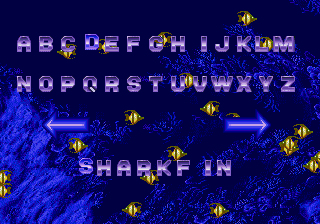
At its core the password system used in Tides of Time has been mostly inherited from the original game with the same 8-letter codes and familiar menu to put it in. A basic level password in Ecco 2 stores the following information:
- Total game time played
- Current difficulty setting
- Player’s death count or difficulty points
- Stage ID
- Asterite's current globe pairs count

Password Data Packed
Yes, the game does keep track of how long you have played it by counting the number of frames that have been rendered. Personally, I am not convinced that was really the end goal here and this data is more likely included to make passwords more random – even for the same stage where all other parameters remain the same.
This can still be used as a good enough estimate of how long it took someone to beat the game as well as to detect possible timing inconsistencies, therefore both password generators on our website will decode and display this information in human-readable format.
It is also worth noting that passwords for different editions of the game are interchangeable and, for example, a code from Mega CD version will work in a cartridge based game and vice versa. This differs from Ecco 1 where every edition would use a different key to decode it!
You must rebuild The Asterite

The field for Asterite Globes comes into play when it’s time to start collecting them. That counter will start at 1 in the beginning of the game until we reach Moray Abyss and store our progress afterwards.
There is, however, another hidden role for it as that information is also used by the game to verify against the Stage ID via an internal lookup table. If, for example, a password has been decoded successfully, but the data inside says Asterite has 8 globe pairs whilst current level is Dark Sea where he’s supposed to be whole, or we’re at Crystal Springs that’s supposed to only have 1 pair, such a password will be rejected.
Obviously, such checks require developers know in advance the exact sequence of levels you are supposed to go through which is exactly why beta versions do not have that. This is also one of the reasons Ecco 2 has much less chance of repeating letters or seemingly significant words (such as LIFEFISH or SHARKFIN) to be accepted as a valid password unlike in the first game.
I forget how many times…
If you have read the first article in the series dealing with how Dynamic Difficulty works in Ecco 2, you already know that the game would store inside a password how many times the player has died or their current Difficulty Points if Normal difficulty is in effect.

You may even recall how points data has one extra bit allowing them to go up to 31 whilst deaths counter stops at 15… which turns out to also be the maximum that’s stored in the password as that field is only 4 bits long. The game does an explicit check for this when generating a new one and will cap the value at that.
We can call this “password forgiveness”: even if the player has not been doing too well during their Normal playthrough, loading a game would continue with only 15 points rather than 31, meaning less levels to win before Hard Mode kicks in. This is most likely an oversight by the programmers and could be an indication Dynamic Difficulty was introduced much later during development.
Cheat? I would never!
Picture yourself this: you are on the final level of Tides of Time, having put many hours (days, weeks) into the game. You finally beat all the monsters and get to the level exit… Only to then see this dreaded message:
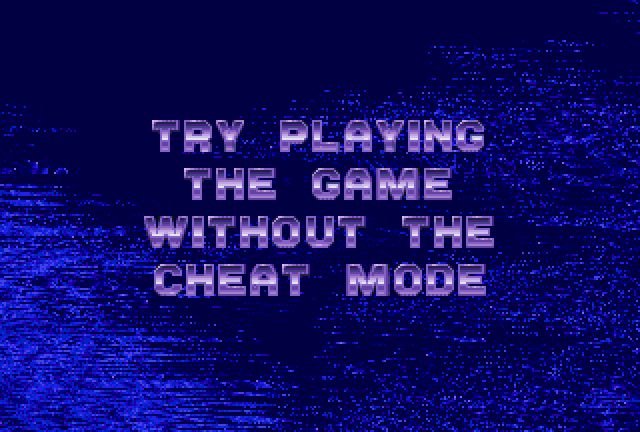
Yours truly had that happen to him back in 1995, and I certainly remember being both very confused and frustrated at the same time. It’s true that both Ecco games can detect whether the player has cheated and penalise them for that, however here it seems prone to false trigger given how quite a few people in the Ecco community have reported this happening to them also. So what gives?!
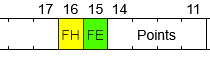
The answer lies in the way the game stores the current difficulty settings in the password data as was shown above. Two 1-bit flags are used for it to indicate whether the game is in Forced Easy (FE) or Forced Hard (FH) mode. Normal mode would have both flags set to zero. There is, however, another possible combination.
If at any point during the game the player would open the debug menu a special flag will be raised in the program to indicate Cheat Mode has been used. This will be then stored in the password by setting BOTH of those flags to “1” – the fourth possible state.
However, this can also happen on accident when the password is being generated to be shown to the player or after it’s been entered and is being decoded.
Technical details on that are available in Chapter 2 of this article but what is important to know here – IT IS NOT YOUR FAULT, this is just a bug in the code that seems to have a higher chance to manifest itself the more you are using the password system.
Rather thankfully, there is an easy way to check whether your password got corrupted without having to beat the entire game. As soon as a password has been recognised as having the Cheater flag set, this sound effect will be played back when it’s accepted:
The Wop of Shame
My personal recommendation therefore would be to write down all the passwords that you receive and try going back to a previous one in case the game decided to play dirty on you that day.
Hiding the Secrets
Assuming we have cleared the game the normal way and password system glitch gremlin has been kind to us that day, the player would get the actual Secret Password instead of the dreaded “You’ve cheated” screen.
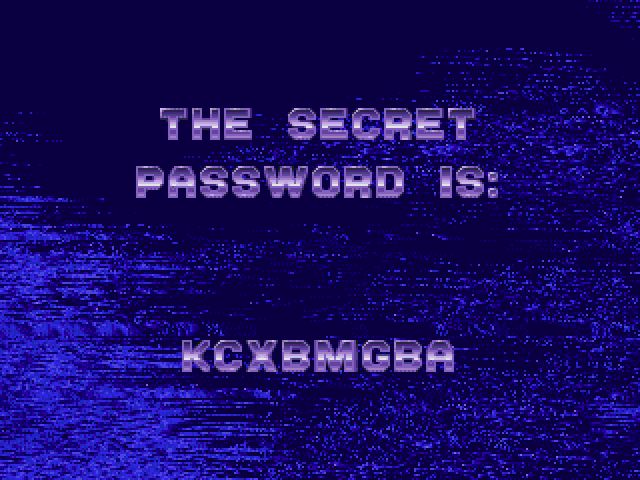
According to game developers, the password could then be entered in the beginning of the sequel that never happened and would have an effect on how the game would start. Quite similarly to Tides of Time, Ecco 3 would continue exactly where the previous game had left off, so having a password to carry over some of the player's achievements does certainly make sense.
But what kind of information does the Secret Password actually contain? Well, if you thought that looks not too dissimilar to a regular level password, it's because that’s exactly what it is! In fact, the Epilogue is technically treated by the game as if it were just a regular level with its own password screen and the only thing that sets it apart is that it has its Stage ID of 63. Whenever a password screen is shown for a level, the game checks for that magical number and will override the level name with the message for the player. Depending on whether Cheat Mode flag mentioned above has been set, the game would then either give us the password or hide it and tell us to try again.
To sum it up, the Secret Password is in reality just like any other password the game would give you and the only thing that sets it apart is that it has the Stage ID field set to 63. Therefore it’s difficult to tell what kind of useful information could be extracted from that in the sequel, but perhaps developers had their reasons.
Would you like it easy?
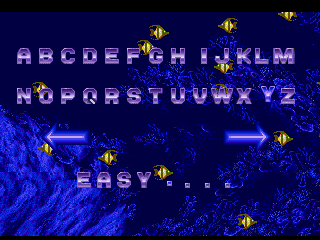
While Tides of Time does not have any memorable passwords such as LIFEFISH or PLEASE--, there is still one exception. When Revision 1 of Ecco 1 was made in 1993, which is essentially a US version with all the quality of life changes backported form the Japanese release, you could enter EASY as a password to make the game even shorter.
Ecco 2 has inherited this just as well which is done as one and only hard-coded check before password is passed on to the validation. The fun part is that the game only checks the first four letter of the password and the rest can be anything or left blank. All that code it does in Tides of Time, however, is just start the game on Forced Easy difficulty – the same as if you swam through the diagonal tunnel in the selection screen. It is therefore not quite clear why this code was left in after the selection screen was added into the game and it’s entirely possible developers just forgot about it.
In conclusion
The Ecco 2 password system is the logical evolution of that used in the first game. It retains the familiar 8-character formula but uses stronger sanity checks that significantly reduce the change to soft-lock the game by entering a password containing impossible data combinations. At the same time it appears to be prone to accidental data corruption that would cause the game to think the player has cheated and some of the features look rushed and incomplete. The Secret Password given to the player in the end stores the same information a regular level password would and the only thing that sets it apart is a special Stage ID.
Now that you have a better understanding of how save system works in Tides of Time, we can continue to the Page 2 of the article to explore the technical side of it with code analysis and more!